
Solo Female Travel: Everything You Need to Know Before Your First Trip (2026 Guide)
So, you’re thinking about taking a trip. Maybe you’ve been thinking about it for months. Maybe you’ve already opened the Skyscanner tab three times this week, hovered over “Book,” then closed your laptop and gone to make a snack instead. Here’s the thing: solo female travel is having a moment — and not in a fleeting, micro-trend kind of way.
Women now make up an estimated 84% of all solo travelers worldwide, and searches for “solo female travel” have jumped fivefold since pre-pandemic levels. This isn’t a niche anymore. It’s the main character era of travel, and you’re invited.
But “just go!” is annoying advice when you’ve never done it before. So this is the guide I wish someone had handed me before my first solo trip — what to actually book, where to actually go, what to pack, what to skip, and how to handle the moment you’re sitting alone at a restaurant wondering if everyone is staring at you. (Spoiler: they’re not. They’re looking at their phones, like the rest of us.)
Why Solo Female Travel Is Exploding in 2026
Quick stats so you know you’re in good company:
- The global solo travel market hit $549 billion in 2025 and is on track to nearly triple by 2033.
- Solo female travel has surged 131% since 2024. That’s not a typo.
- 39% of solo travelers are now 40 or older — and women over 45 are leading the trend, often booking $18,000+ trips.
- 21% of women plan to take a women-only group trip in 2026. Group, solo, or somewhere in between, you have options.
Translation: the version of solo travel that used to feel “brave” or “unusual” is now genuinely mainstream. You’re not weird. You’re early-ish to a trend that’s about to feel obvious in three years.
How to Pick Your First Destination (Without Spiraling)
The number one rule for your first solo trip: make it easy on yourself. Save the visa-required, off-the-grid, three-flights-and-a-boat trip for round two. For your first, you want somewhere with great infrastructure, friendly locals, English widely spoken, and a low effort-to-magic ratio.
Here are the destinations consistently topping the safety and ease lists for 2026:
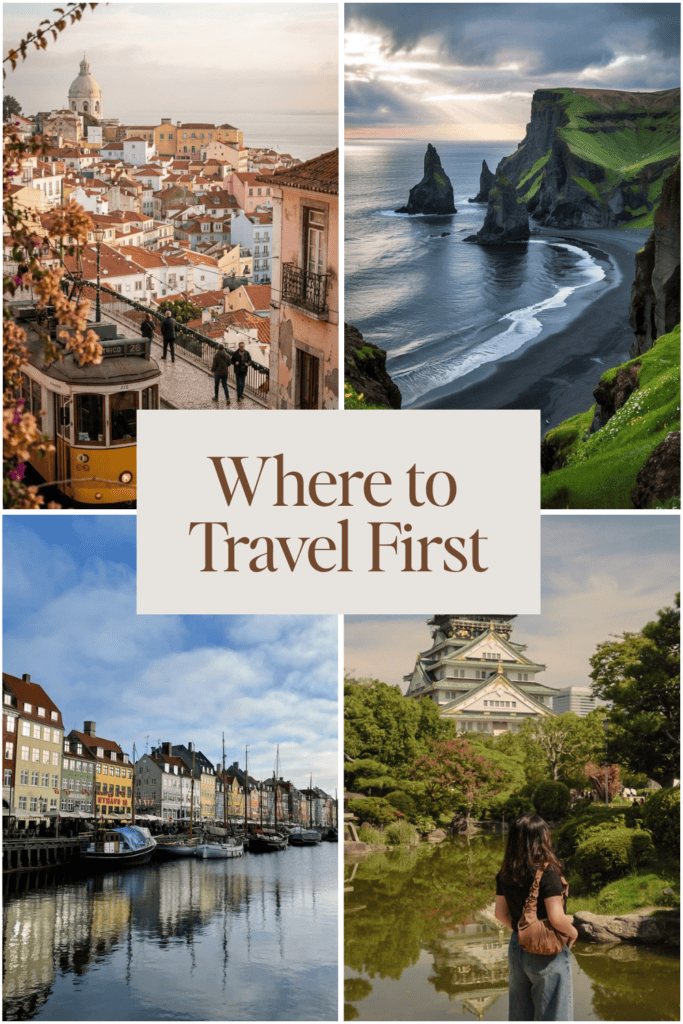
The “Can’t Go Wrong” Tier
- Iceland — Ranked the world’s safest country for solo female travelers for the 14th year in a row. Stunning, walkable, English everywhere, and the chances of someone bothering you are roughly zero.
- Japan — Clean, punctual, ridiculously safe, and even the convenience stores are an experience. Solo dining is a normal cultural activity here, so no one will blink.
- Portugal — Affordable, sunny, gorgeous food, very welcoming to solo travelers. Lisbon and Porto are dream first trips.
- Denmark — Tops the 2026 safety index with a near-perfect score. Copenhagen is small enough to feel manageable, big enough to feel like an adventure.
The “Underrated and Should Be Booked” Tier
- Estonia — Quietly crushing the 2026 safety rankings. Tallinn is gorgeous, walkable, and shockingly affordable.
- Vietnam — The gold standard for affordable solo travel. Robust backpacker infrastructure, warm reception for solo women, and the food is — we cannot stress this enough — life-changing.
- Costa Rica — Best pick if you want nature, adventure, and a built-in solo traveler scene. The hostel-to-yoga-retreat pipeline is real.
- Ireland — Friendly people, beautiful countryside, pub culture that’s easy to enjoy alone.
Skip For Now (For Your First Trip)
We’re not saying never, we’re saying not yet. Destinations with complicated visas, intense language barriers, low female solo traveler infrastructure, or current travel advisories should go on your “trip three or four” list. There’s no medal for picking hard mode on round one.
What to Actually Pack (The Honest List)
The Non-Negotiables
Skip the Pinterest packing list with 47 items. Here’s what genuinely matters:
- An anti-theft crossbody bag. Pacsafe, Travelon, or anything with locking zippers and slash-proof straps. Pickpockets are real, especially in tourist cities. Don’t make it easy for them.
- A portable door lock or door alarm. Tiny, costs $15, sleeps better. Especially clutch in budget hotels and Airbnbs.
- A power bank. A dead phone is the single fastest way for a solo trip to get stressful.
- Copies of your passport — one digital (saved to email + cloud), one physical, stored separately from the original.
- A debit/credit card from two different banks, stored in two different places. If one gets eaten by an ATM or stolen, you’re not stranded.
- Travel insurance. Yes, even for a five-day trip. World Nomads, SafetyWing, or Allianz. This is non-negotiable. Future-you will thank present-you.

The Quality-of-Life Upgrades
- A real water bottle (the airport will sell you back your own water for $9 if you let it).
- Compression packing cubes — they’re a meme for a reason.
- One “fancy” outfit that makes you feel like a movie character at dinner.
- Noise-canceling earbuds for the plane and the inevitable noisy hostel.
- A book or e-reader. Solo dinners are infinitely better with a good book in your bag.
The Honest Skip List
Curling irons, full skincare regimens in glass bottles, “just in case” sneakers, and the seventh pair of underwear. You will not wear half of what you pack.
Safety Tips That Actually Work (Beyond “Be Aware of Your Surroundings”)
Real talk: you’ve been navigating the world as a woman your whole life. You already know more about safety than you give yourself credit for. These are the travel-specific additions:
Before You Go
- Research the actual local norms. What do women wear? How do they greet people? Is it normal to make eye contact with strangers? Knowing this in advance helps you blend in, and blending in is a safety strategy.
- Share your itinerary with one person back home. Send hotel names, flight numbers, and a daily-ish “I’m alive” text. Use Find My Friends, Life360, or just iMessage check-ins.
- Save offline maps. Google Maps lets you download whole cities for offline use. Do this for every place you’re going.
- Pre-book your first night’s accommodation. Arriving exhausted and trying to figure out where to sleep is how you make bad decisions. Have it locked in before you land.
Once You’re There
- Arrive before dark whenever possible. Daylight gives you a sense of the neighborhood, the transit, and whether you accidentally booked a hotel above a nightclub.
- Wear your bag in front of your body in crowds. Cute? No. Necessary? Yes.
- Don’t broadcast that you’re traveling alone — to strangers, on Instagram stories in real-time, to taxi drivers. A vague “meeting a friend later” works in 90% of awkward situations.
- Trust your gut, immediately. If a vibe is off — a bar, a guy, a taxi, a vibe in the street — leave. You don’t owe anyone a polite explanation. Awkwardness is a small price for safety.
- Get a local SIM or eSIM so you always have data. Airalo and Holafly are easy. Being unable to pull up a map or call a Lyft equivalent is the worst.
- Know two phrases in the local language: “Help” and “I’m lost.” That’s it. You don’t need to be fluent.
The Hardest Part: Eating Dinner Alone
Let’s address it directly because it’s what stops a lot of women from going.
The first solo dinner is awkward for approximately seven minutes. Then you order, the food arrives, you open your book or your phone, and you realize the whole restaurant is just… people eating. Nobody is staring. Nobody is whispering, and nobody cares.
A few hacks that help:
- Sit at the bar. Bartenders are great conversationalists, food comes faster, and you can people-watch without feeling on display.
- Bring a book or journal, not just your phone. It signals “I am content,” and gives your hands something to do.
- Book a food tour on day one. It’s the single best way to meet other solo travelers AND eat well. Walking food tours, cooking classes, and small-group day trips are the secret weapon.
- Order the local specialty. You’re here to experience it. Make the meal the event.
By dinner four, you’ll be smug about how much better solo dining is. You order what you actually want. You leave when you want. And most importantly, you don’t have to share the fries.
How to Meet People (If You Want To)
You don’t have to. Solo travel is a perfectly valid reason to spend a week not talking to anyone but baristas. But if you do want company, it’s shockingly easy:
- Hostels — even if you book a private room. The common area is a solo traveler magnet.
- Walking tours — free or paid. Built-in icebreaker.
- Cooking classes, day tours, group hikes — anything where you’re doing something with strangers.
- Apps: Bumble BFF, Meetup, Couchsurfing Hangouts, Eatwith, and the Solo Female Travelers Club Facebook group.
- Yoga or fitness classes — drop-ins are normal, and you’ll meet locals.
The trick is to start with one social activity per day, max. Solo travel is also about being alone. Don’t fill every hour.
Budget Reality Check
The single biggest myth about solo travel is that it has to be expensive. Yes, you pay the “single supplement” on tours and lose the split-the-Airbnb savings. But you also:
- Eat whatever you want, whenever
- Skip activities you don’t care about
- Book the smaller, cheaper room
- Don’t compromise on anything
A reasonable budget for a first solo trip:
- Europe (Portugal, Estonia, Ireland): $100-150/day mid-range
- Iceland, Denmark, Japan: $200-300/day mid-range (these are pricey but worth it)
- Vietnam, Thailand, Costa Rica: $50-80/day mid-range
Add flights, travel insurance ($40-80 for a week), and a buffer of 15-20% for “treat yourself” moments and unexpected costs.
Frequently Asked Questions
Is solo female travel actually safe?
The data says yes — 59% of women report feeling safe traveling solo, and the vast majority of trips happen without incident. Safety depends far more on destination choice and preparation than on traveling alone vs. with others. Pick a beginner-friendly country, do your research, trust your instincts, and you’ll be fine.
What’s the best first solo trip destination?
For most first-timers: Portugal, Iceland, Japan, or Ireland. They’re safe, walkable, well-set-up for solo travelers, and English is widely spoken. Pick whichever calls to you most.
How long should my first solo trip be?
Five to ten days is the sweet spot. Long enough to feel like a real trip, short enough that you’re not committing your savings or your sanity. You can always extend round two.
Will I get lonely?
Sometimes. It’s part of it. The loneliness is also where the magic is — it’s where you realize you actually like your own company, where the trip becomes yours, and where the best stories happen.
What if something goes wrong?
Travel insurance, copies of your passport, two cards in two places, a charged phone, and your country’s embassy on speed dial. The worst-case scenarios are almost always solvable. You’re more capable than your anxiety is telling you.
Do I need to speak the local language?
No. Google Translate, a phrasebook, and a smile cover 95% of situations. Learning “hello,” “thank you,” “please,” and “where is the bathroom” goes a long way.
The Pep Talk
Here’s the part nobody tells you: the version of you that comes back from a solo trip is not the same version that left.
You’ll eat meals in a country where you don’t speak the language. You will navigate a metro system that made no sense an hour ago. You will figure out a problem at 11pm with no one to ask. And you may very well find yourself sitting on a bench in a city you’ve never been to and realize that you got yourself here. That feeling — that quiet, smug, slightly emotional “I did this” — is the whole point.
The trip is the souvenir. The pictures are nice. But the version of you that knows she can do hard, beautiful, scary things? She’s the keepsake.
So open the Skyscanner tab. Pick a date six to eight weeks out. Book the flight. The rest will figure itself out — they always do. And for even more travel ideas and inspo, click here!
Xx Monti
Shop the Post
